I never planned on becoming a fiddler.
In my early twenties, I was working in a violin shop helping customers choose instruments and accessories. My world revolved around classical violin. I had spent years studying technique, reading sheet music, and learning to approach every note, articulation, and bow stroke with precision.
Then one phone call changed everything.
A local country band contacted the shop looking for a fiddler.
The funny thing was…
I didn’t even know what a fiddle really was. I knew people sometimes called violins “fiddles,” but I had never seriously explored country music.
At the time, I wasn’t even a country music fan.
Curiosity got the better of me. I started listening, learning fiddle tunes, studying recordings, and experimenting with a completely different way of making music. Before long, I joined the band and eventually moved to Nashville, where I spent years performing country music.
Somewhere along the way, I completely fell in love with fiddle playing. Not because it replaced classical violin.
Because it opened an entirely different musical world.
That journey eventually led me to write Fiddle For Dummies and teach students who wanted to become fiddlers. And one question followed me through all of it:
What’s the real difference in the fiddle vs violin debate?

💡 What You'll Learn
- Whether a fiddle and violin are actually different instruments
- The 6 fiddle vs violin differences that matter most
- Why improvisation changes the way a fiddler thinks
- How bowing, slides, double stops, and musical vocabulary shape the fiddle sound
- Whether a fiddle needs a different physical setup
- Whether fiddle is easier than classical violin
- How to decide which direction fits your musical goals
What Is the Difference Between a Fiddle and a Violin?
Let’s begin with the simple answer.
A fiddle and a violin are the same instrument.
If you walked into my studio carrying a violin and called it your fiddle, you’d be right. If another student walked in with the exact same instrument and called it a violin, they’d also be right.
The wood is the same. The strings are the same.
The instrument hasn’t changed.
The musical style has.
When people say “violin,” they are usually describing the instrument in a classical context. When they say “fiddle,” they are usually describing that same instrument in a folk, country, or traditional musical context.
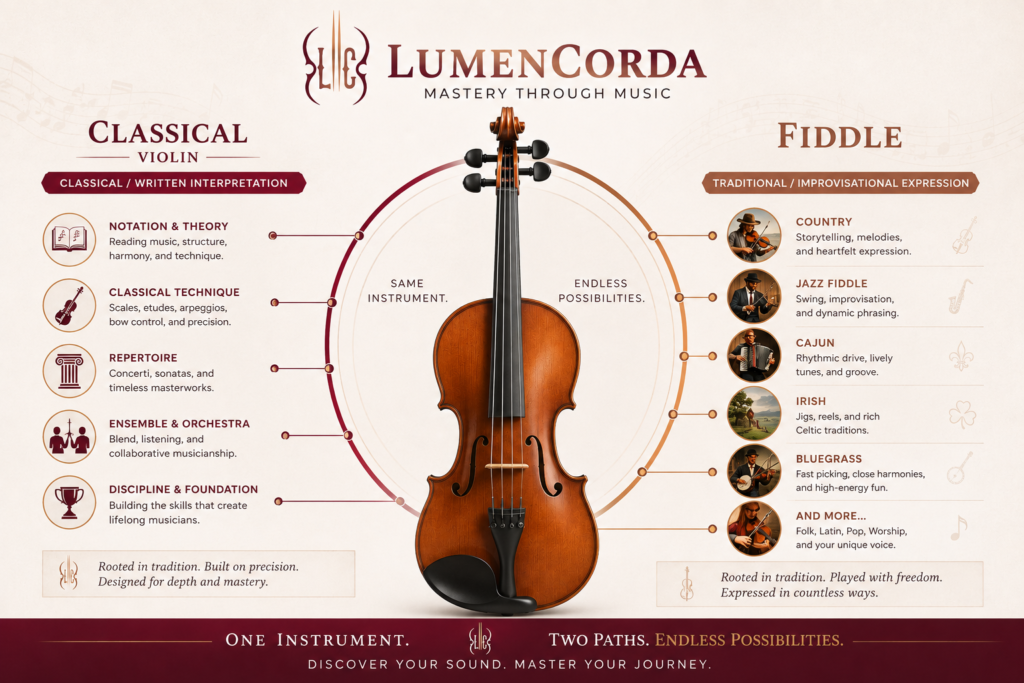
Why Fiddle vs Violin Sounds Like Two Different Instruments
If the instrument is the same, why can the two approaches sound so different? Because the biggest fiddle vs violin difference has very little to do with the violin itself.
It has everything to do with how the musician thinks. Classical training often asks, “How faithfully and beautifully can I bring the composer’s music to life?”
Fiddle playing often asks, “How can I make this melody come alive right now?”
Neither approach is better.
They’re simply different.
My Journey From Classical Violinist to Fiddler
When I first started playing fiddle, I approached it exactly the way I’d been trained to play classical violin. Every solo sounded the same.
Every bowing stayed the same. Every note was played exactly as I had practiced it.
I wanted consistency.
Then I joined a country band.
Everything changed.
The band didn’t want me to reproduce the exact same solo every night. They wanted me to listen, react, improvise, and create fills between the vocals. Some nights I’d play one lick.
The next night I’d play something completely different. At first, that was incredibly uncomfortable.
After years of classical training, I was used to believing there was one correct way to perform the music in front of me. Suddenly, there were dozens of possibilities. I wasn’t simply learning a new style of violin playing.
I was learning a different way of thinking about music.
Classical violin taught me how to play accurately. Fiddle taught me how to create music in the moment. Becoming a complete musician meant learning both.
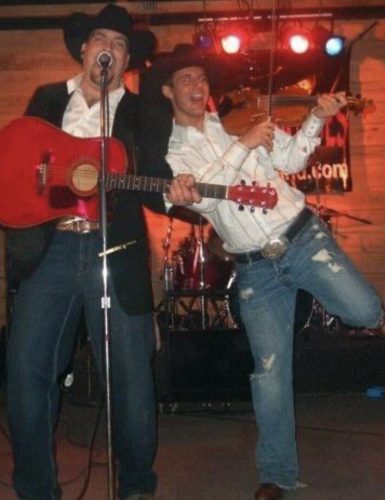
This is me playing fiddle for the band “Stolen Horses” in my early 20s with lead singer David Lyle.
Fiddle vs Violin: 6 Differences That Actually Matter
1. The Musical Mindset Is Different
This is the biggest difference for me.
Classical violin generally places the written composition at the center of the performance. The player brings that music to life through tone, phrasing, dynamics, articulation, and interpretation. Fiddle gives the player more freedom to reshape what happens.
The melody can become a framework.
Not a set of handcuffs.
2. Improvisation Plays a Much Bigger Role
When beginners compare fiddle vs violin, they often notice the obvious things first.
The slides. The double stops. The faster passages.
But the biggest musical difference is often improvisation.
In much of classical violin, your creativity lives inside the interpretation of a written score.
In fiddle, the melody can become your starting point.
You might slide into a note.
Add a quick lick.
Play a harmony.
Leave extra space.
Or respond differently to the musicians around you.
That freedom is one of the reasons I fell in love with fiddle playing.
No two performances had to feel exactly the same.
Me performing “The Devil Went Down to Georgia” in my early 20s. The fast “Devil” section was never played exactly the same way twice—that freedom to improvise and respond in the moment is one of the things I’ve always loved about fiddle playing.
3. Great Fiddlers Learn to Listen and Leave Space
One of the biggest lessons Nashville taught me was that being a great fiddler isn’t about playing more notes.
It’s about listening.
The singer tells the story.
The steel guitar answers.
The fiddle responds.
The guitar fills another space.
A good band is having a musical conversation.
Great fiddlers know when it’s their turn to speak.
And when it’s time to stay silent.
One of the biggest mistakes a fiddler can make is overplaying. Great musicians don't just know what to play—they know when silence makes the next phrase more powerful.
4. The Bow Often Creates the Style
Most beginners stare at the left hand because that’s where the notes are.
But the right hand often creates the style.
Two musicians can play the exact same pitches and still sound completely different.
Why?
Because of the bow.
Rhythmic accents, bow direction, articulation, groove, and the way notes connect can completely change the personality of a melody.
Play a simple eight-note melody twice. First, make every note even and smooth. Then play the exact same pitches while changing the accents, shortening a few bow strokes, and leaning into the beat. Listen to how much the personality changes without changing a single note.
5. Slides, Double Stops, and Licks Become Musical Vocabulary
Fiddle sound isn’t created by one trick.
It’s a collection of musical choices.
Slides can create anticipation and personality.
Double stops can make the instrument sound fuller, richer, and more rhythmic.
Licks become small pieces of musical vocabulary that a player can combine and reshape in the moment.
I think of them like familiar phrases in conversation.
You don’t invent every sentence from nothing.
Over time, your brain collects useful musical ideas and learns when to use them.
The key is taste.
A slide into every note stops sounding expressive very quickly.
The goal isn't to slide into every note. The goal is to make the listener feel something when you choose to.
6. Setup and Musical Goals Can Be Different
This is where the fiddle vs violin question can become confusing.
If they’re the same instrument, why do musicians talk about a “fiddle setup”?
Because some experienced fiddlers adjust a standard violin to suit the way they play.
That does not mean a beginner needs a special fiddle.
Some players prefer a slightly flatter bridge to make certain double stops and string crossings feel easier.
Some choose different strings.
Many like fine tuners on all four strings for quick tuning.
Chin-rest and shoulder-rest preferences vary tremendously.
None of those changes turn a violin into a fiddle.
The musician matters far more than the setup.
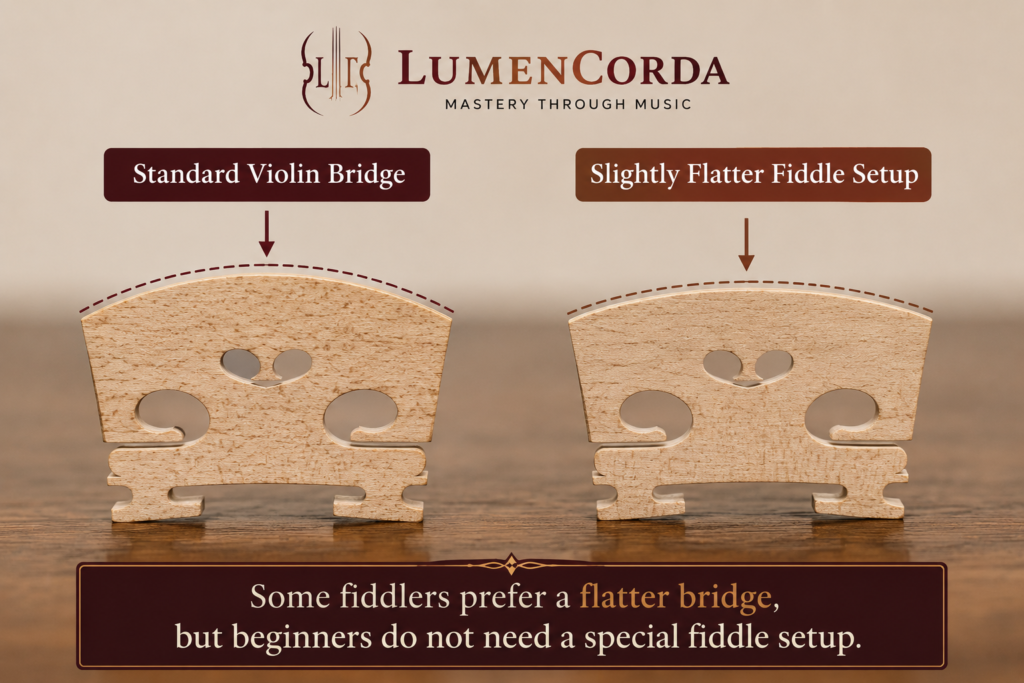
The playing context can be different too.
Classical violin often revolves around written repertoire, solo performance, chamber music, or orchestra.
Fiddle is often more social.
You may be playing in a band, at a jam, accompanying a singer, playing at church, or making music with friends.
That changes what musicians practice.
A classical player may spend enormous time refining a written phrase exactly as intended.
A fiddler may spend that same time learning to create fills, lock into a groove, or improvise over a familiar progression.
Neither approach is better.
They’re asking different things from the player.
Why Is It Called a Fiddle Instead of a Violin?
If they’re the same instrument, why do we have two different names?
The answer is rooted in history.
The word “fiddle” has older roots connected to earlier names for bowed string instruments, while “violin” came into English through the Italian violino.
Over time, the words became associated with different musical settings.
“Violin” became strongly connected with concert halls and classical traditions.
“Fiddle” remained common in folk, dance, and traditional music.
The instrument didn’t change.
The tradition did.
Is Fiddle Easier Than Classical Violin?
This is one of the questions I’m asked most often.
The answer depends on what you mean by “easier.”
Can you begin playing enjoyable fiddle tunes sooner than advanced classical repertoire?
Yes.
Many fiddle tunes stay in first position and use familiar keys, so students can begin making recognizable music relatively early.
But is becoming an exceptional fiddler easier than becoming an exceptional classical violinist?
No.
Advanced fiddle playing can demand tremendous speed, clean intonation, rhythmic control, double stops, improvisation, listening, and creativity.
Advanced classical violin asks for a different set of highly developed skills.
Neither path is easy.
The challenges are simply different.
Don't choose fiddle because you think it's easier. Choose it because you love the music. Passion will carry you much farther than taking what looks like the easier road.
Which Should You Learn: Fiddle or Violin?
Choose classical violin if you’re excited by orchestral playing, concert repertoire, reading music, structured interpretation, or building the broadest traditional technical foundation.
Choose fiddle if you imagine yourself playing in a band, joining a jam, accompanying singers, improvising, or simply making the kind of traditional music that makes you want to pick up the instrument.
But here’s the good news.
You don’t have to choose forever.
Both worlds live on the same instrument.
I’ve taught students who started with classical violin and later fell in love with fiddle.
My own musical path changed dramatically too.
When I first started exploring country music, I wasn’t even a country fan.
Years later, I had moved to Nashville and couldn’t imagine not playing it.
Don't worry about locking yourself into one musical path forever. Learn the instrument well, and you'll have the freedom to enjoy whatever music inspires you.
If you’ve decided fiddle is the direction that excites you, the next question is how to learn fiddle without creating technical habits that hold you back later.
That’s exactly what I cover in the companion guide: How to Learn Fiddle: 7 Powerful Steps for Beginners.
🎻 Not Sure Which Musical Path Fits You?
Maybe you love the sound of fiddle but also want strong violin fundamentals. Maybe you're not sure whether classical violin, fiddle, or a combination makes the most sense for your goals. My free Violin Path Assessment is designed to help you identify the direction that fits your experience, interests, and playing level.
Take my Free Violin Path AssessmentFrequently Asked Questions
Are a fiddle and a violin the same instrument?
Yes. In most cases, fiddle and violin refer to the same four-string bowed instrument. The difference usually describes the musical tradition and the way the instrument is played rather than a different instrument. You do not need to buy a separate instrument just because you want to play fiddle music; the musical approach is what changes most.
What is the biggest fiddle vs violin difference?
In my experience, the biggest difference is musical mindset. Classical violin generally emphasizes interpreting written music, while fiddle often gives the player more freedom to vary, improvise, and respond to other musicians. That shift was the biggest adjustment for me when I moved from classical playing into country music, because I had to learn to listen and create in the moment rather than reproduce the same version every time.
Do fiddles and violins sound different?
They can sound very different even when the instrument is identical. Bowing, rhythm, slides, double stops, phrasing, and improvisation can make the same violin sound unmistakably like fiddle. I can take the same violin and make it feel much more classical or much more like fiddle simply by changing the bowing, phrasing, accents, and ornaments.
Are fiddles and violins tuned differently?
Usually no. Standard tuning for both is G-D-A-E. Some fiddle traditions use alternate tunings, but beginners can learn fiddle in standard violin tuning. Alternate tunings do exist in some traditions, but I would not make that a priority for someone just starting out.
Do I need to buy a fiddle instead of a violin?
No. A quality violin can be used to learn fiddle. Some experienced players later adjust the bridge, strings, fine tuners, or other setup details, but those changes are not required to begin. I would much rather see a beginner put energy into posture, bow control, intonation, and listening than worry about whether the label on the instrument says violin or fiddle.
Is fiddle easier than violin?
Fiddle can let beginners enjoy certain tunes relatively early, but high-level fiddle playing is not easy. It requires advanced rhythm, bow control, listening, improvisation, speed, and intonation. Many tunes are accessible in first position, which can make the early stages feel approachable, but playing them with great rhythm, tone, intonation, and musical taste is a much higher bar.
Can a classical violinist learn fiddle?
Absolutely. Classical technique can provide an excellent foundation. The biggest adjustment is often developing groove, listening, stylistic bowing, improvisation, and comfort moving beyond the written page. That was essentially my own path, and the classical foundation helped me tremendously even though I had to develop a different musical mindset.
Can a fiddler play classical violin?
Yes, although advanced classical repertoire may require reading and technical skills a fiddle-only player has not developed. Because the instrument is the same, many fundamentals transfer in both directions. A strong technical foundation keeps both doors open, which is one reason I care so much about fundamentals even when a student's long-term goal is fiddle.
Michael Sanchez
Michael Sanchez is the founder of Lumen Corda, author of Fiddle For Dummies, and a violin educator with more than 25 years of teaching experience. He has helped hundreds of students develop stronger technique, greater confidence, and a deeper understanding of the violin. His teaching philosophy is simple: understanding creates better technique.
More About Michael