One of the biggest misconceptions I see as violinists reach the intermediate level is that they think they’re beginning to graduate from the fundamentals.
In my experience teaching violin for more than 25 years, almost the opposite happens.
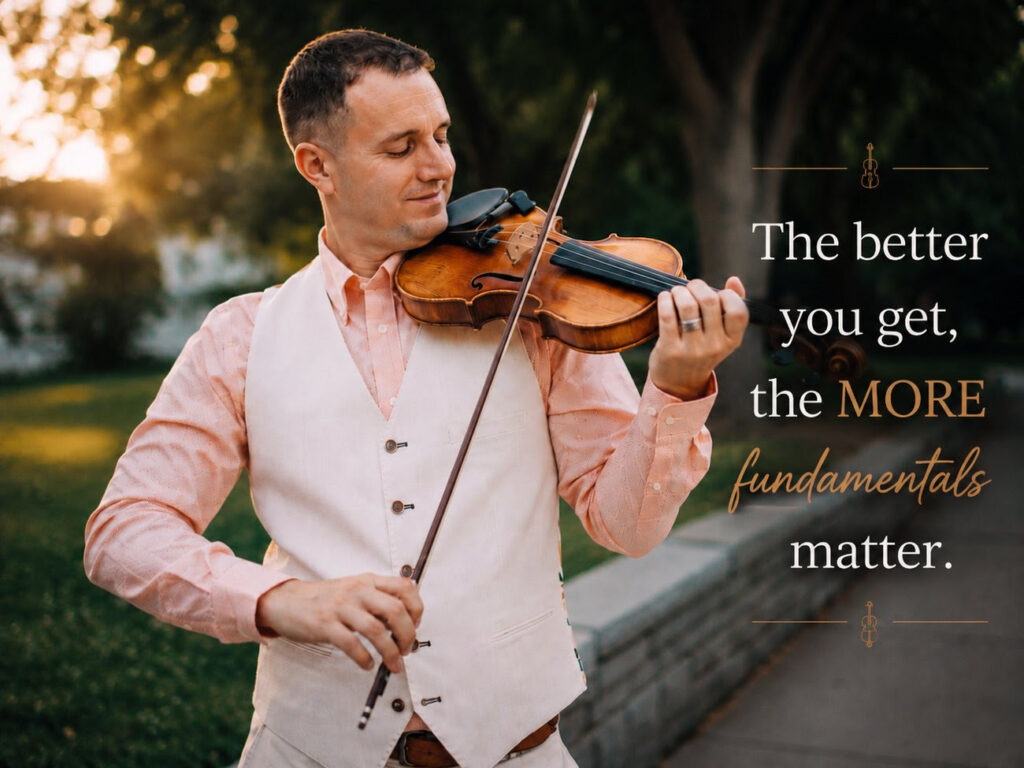
The better you get, the MORE your fundamentals matter.
Harder music has a way of exposing things. A slightly inefficient left hand may not bother you much during a simple first-position melody, but add a fast passage, fourth finger, shifting and string crossings, and suddenly that little inefficiency becomes a much bigger problem.
That’s why I continued talking about fundamentals with students even as they progressed into more difficult Suzuki repertoire, third and fifth positions, vibrato, etudes and orchestra music.
If you’re an intermediate violin player who feels like you’ve hit a plateau, you may not need to race toward another advanced technique.
You may need to take the skills you already have and make them better.
What You'll Learn in This Article
- Why harder violin music often exposes fundamental weaknesses
- How scales and etudes help intermediate violinists improve intonation, shifting, rhythm and technique
- Why hand height, finger pressure and violin support become even more important as you advance
- How I approach rhythm, articulation, dynamics, vibrato, interpretation and tempo
- How to structure intermediate violin practice so you're improving instead of simply progressing through repertoire
What Is an Intermediate Violinist?
There’s no single piece or Suzuki book that suddenly makes someone an intermediate violinist.
For the purposes of this lesson, I’m thinking primarily about advancing students who are moving beyond basic first-position playing, beginning or developing third position, eventually reaching fifth position, and working through increasingly demanding repertoire.
At this stage, you probably already know how to play the violin.
The question becomes:
How well can you do everything you already know how to do?
Can you play in tune when the key changes?
Can you shift consistently rather than guessing where the note will be?
Can you maintain good left-hand position when the passage gets faster?
Can you play the correct rhythm while also paying attention to articulation and dynamics?
Can you use vibrato as part of the music rather than simply putting the same vibrato on every note?
Those are intermediate violin questions.
And many of the answers still come back to fundamentals.
1. Don't Graduate From Your Violin Fundamentals
When a piece gets harder, students sometimes assume the piece itself is causing their problem.
“I can’t play this passage fast enough.”
“My fourth finger is always out of tune.”
“I can’t hit this shift.”
But I learned to ask a different question when teaching:
What is the difficult passage exposing?
If you’re pressing your fingers into the fingerboard much harder than necessary, you may not notice much of a problem while playing slowly. Once the notes get faster, though, all that unnecessary effort starts limiting your dexterity.
The same is true of the bow. A small bow-hand issue may hide during long notes and then become obvious when you encounter fast articulation, string crossings or accents.
This is why I sometimes took intermediate students right back to exercises they might have considered “basic.”
We’d do the rocking bow drill. We’d check finger pressure. We’d look at the thumb, hand height or how the violin was being supported.
Going back to a fundamental isn’t going backward. Sometimes it’s the fastest way forward.
Harder music doesn't necessarily create your technical problems. It exposes them.
2. Make Violin Scales Part of Your Musical DNA
I didn’t practice scales as much as I should have when I was young.
After teaching hundreds of students, I appreciate them a lot more now!
Early scale work commonly begins with keys such as G, C and D. As the student develops, I want them branching into F, B-flat, E-flat, A major and many others while progressing through one-octave, two-octave and eventually three-octave scales.
Once you’re shifting into third and fifth positions, scales become an especially useful way to develop your map of the fingerboard.
But I don’t want a student simply racing up and down a scale.
A good scale book can give you arpeggios, rhythmic variations, bowing variations and position work that develops much more than your ability to memorize eight notes.
You don’t need to jump into advanced scales before you’re ready. Your scale practice should grow with your playing.
I’ve used the Essential Elements series for years, and I think it provides a very natural progression from a beginning violinist working in first position to an intermediate player beginning to shift and explore more of the fingerboard.
Here are the books I recommend based on where you are in your development:
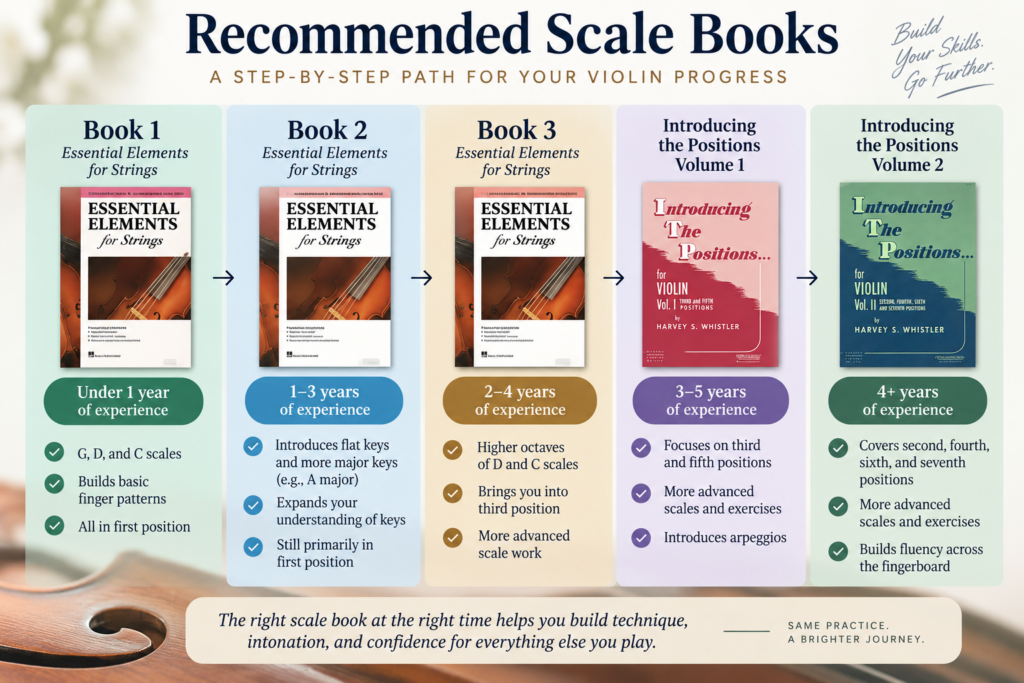
Essential Elements for Strings — Book 1
Best for: Under 1 year of experience
This is where I recommend newer violinists start. You’ll work with foundational scales including G, D, and C while developing the basic finger patterns and technique you’ll need later.
If you’re still getting comfortable playing scales in first position, there’s absolutely no reason to rush past this stage.
Get Essential Elements Book 1 on Amazon →
Essential Elements for Strings — Book 2
Best for: Roughly 1–3 years of experience
Book 2 expands your scale work into additional major keys, including A major, while introducing flat keys as well. You’re still primarily working in first position, but your understanding of keys and finger patterns starts becoming much broader.
This is a great bridge between beginner scale work and the shifting you’ll encounter later.
Get Essential Elements Book 2 on Amazon →
Essential Technique for Strings — Book 3
Best for: Roughly 2–4 years of experience
This is where things start getting especially useful for an intermediate violinist. You’ll begin working with higher-position exercises and shifting, along with more advanced scale work.
As you extend scales such as D and C into additional octaves, you’ll also start using third position. Now your scales aren’t just teaching you keys — they’re helping you learn the fingerboard.
Get Essential Technique Book 3 on Amazon →
Introducing the Positions for Violin — Volume 1
Best for: Roughly 3–5 years of experience
Once you’re ready to make shifting a more serious part of your practice, Harvey Whistler’s Introducing the Positions is one of my favorite resources.
Volume 1 focuses on third and fifth positions and gives you more challenging exercises for developing position playing. At this stage, I also want students becoming increasingly comfortable with scales, arpeggios, shifting, and navigating the fingerboard rather than simply memorizing individual pieces.
Get Introducing the Positions Volume 1 on Amazon →
Introducing the Positions for Violin — Volume 2
Best for: 4+ years of experience
Volume 2 takes position work considerably further, introducing second, fourth, sixth, and seventh positions.
This is where you’re moving beyond simply “learning third position” and toward becoming comfortable across much more of the violin fingerboard. For advancing intermediate and advanced violinists, that’s an important transition.
Get Introducing the Positions Volume 2 on Amazon →
Don’t Worry Too Much About the Timeline
The experience ranges above are guidelines, not rules.
I’ve taught long enough to know that two violinists who have both played for three years can be at completely different technical levels. One might still benefit tremendously from Book 1 or 2, while another may already be comfortable shifting into third position.
Choose the book that matches what you can actually do on the violin — not how long you’ve owned one.
And remember: the goal isn’t to finish a scale book as quickly as possible. The goal is to use scales to build the technique, intonation, shifting, and fingerboard awareness that make everything else you play easier.
Occasionally, I also like practicing scales with a tuner.
First make sure your violin itself is properly in tune. Then use the tuner as a tool for awareness—not something that makes you obsess over every tiny fluctuation in pitch.
Are you consistently sharp on a certain note?
Do your fourth fingers tend to be flat?
Does your intonation change when you move into a less familiar key?
Those observations matter.
Why Scales Matter Outside the Practice Room
I had a great reminder of this recently while playing violin at church.
We were playing in C-sharp and then moving into E-flat. One is loaded with sharps and suddenly we’re dealing with three flats.
When you’re improvising, you don’t have time to stop and calculate every note.
The scales have to become embedded in your soul.
A strong player should eventually be able to move between different keys without feeling as though the fingerboard suddenly became a different instrument.
This is one area where I’ve seen adult students do particularly well. Younger students often don’t want to practice scales—I certainly didn’t always want to either!
Many of my students in their 50s and beyond understood why I was asking them to do it. When they applied themselves consistently, scales became one of the tools that helped them become very capable players.
Choose one scale you know well and one key you don't feel nearly as comfortable playing. Play both slowly with your violin properly tuned. Listen carefully to the intonation, and occasionally check yourself against a tuner. Don't ask whether you can simply finish the scale. Ask: Do I understand this key?
If you need to make sure your instrument is accurately tuned before doing this exercise, you can use an online violin tuner as a reference.
3. Don't Skip Etudes Just Because You'd Rather Play Pieces
Two names bring back a lot of memories for me:
I learned from etude books growing up and later taught from them heavily with my own students.
Why?
Because an etude can isolate technical challenges in a way that simply playing repertoire doesn’t always do.
Etudes can expose you to difficult rhythmic combinations, shifting passages, bowing patterns, articulation, dynamics and different keys without all of your attention being consumed by performing a piece.
And I wasn’t necessarily assigning an etude and expecting it to disappear the following week.
One etude might take two, three or even four weeks to truly master.
That’s okay.
The point wasn’t to finish the book.
The point was to become a better violinist because of the book.
If you’re new to etudes, don’t worry about completing an entire book. Choose a study that targets something you’re currently struggling with — rhythm, bowing, shifting, articulation or another technical weakness — and stay with it until you’ve actually improved the skill.
4. Stop Making Your Fingers Work So Hard
Finger efficiency becomes increasingly important as your music gets faster.
Many violinists press much harder into the fingerboard than they actually need to. You may be able to get away with this during slower music, but unnecessary pressure becomes increasingly expensive as passages get faster.
Your fingers have to come down.
Then they have to come back up.
Do that hundreds of times while using too much force and you’re making every passage harder than it needs to be.
Use the minimum finger pressure necessary to create a clean note.
This doesn’t only affect speed. Excessive pressure can also interfere with shifting, dexterity and vibrato because the entire left-hand system becomes less free.
Play a sustained note and gradually reduce your finger pressure until the note begins to buzz. Now add only enough pressure to make the note clean again. You may be surprised by how little pressure the violin actually requires. This is also one reason I talk so much about fundamentals when teaching vibrato. Many "vibrato problems" are really finger-pressure, thumb-tension or violin-support problems showing themselves through vibrato.
If you want to explore that relationship more deeply, I explain my violin vibrato fundamentals and the role tension plays in developing a free left hand.
5. Check Your Left-Hand Height Before Blaming Your Fourth Finger
The fourth finger is a common source of frustration for advancing students.
It feels weak. It lands flat. It can’t seem to reach comfortably, especially in faster passages.
So naturally, the student focuses on fourth finger.
Sometimes the fourth finger isn’t really the problem.
The position of the entire hand is.
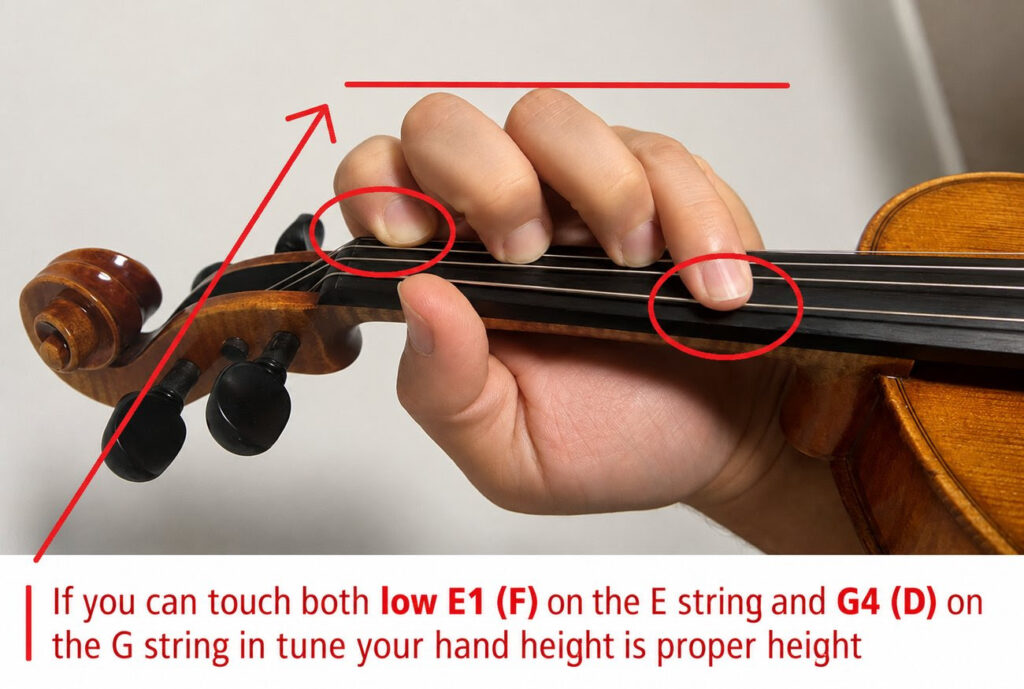
If your hand and knuckles are sitting too low, you’ve made the fourth finger’s job much harder. It has farther to travel and less freedom to work efficiently.
Here’s one of the physical checks I used with students.
Place your first finger low on the E string while simultaneously placing your fourth finger on the G string. Look at your hand. Are your knuckles high enough that your fingers can reach comfortably across the instrument? Or does the hand collapse downward and make the stretch feel extremely difficult? This simple check can reveal a lot about hand height. And hand height doesn't only affect fourth finger. It can affect intonation, speed and overall dexterity.
6. Learn to Shift With Your Whole Hand
When students begin third position, there’s understandably a lot of focus on where the finger needs to land.
But before I worry about the destination, I want to know whether the hand is actually free enough to get there.
If your left hand is helping hold the violin, you’re asking it to perform two opposing jobs.
Hold the violin still AND move freely along the neck.
That’s a problem.
The violin should be supported securely enough that your left hand is free to move along the neck rather than gripping the instrument for support.
Then pay attention to your thumb.
When you shift, your thumb should come along with your hand rather than remaining behind inconsistently. Feeling the neck with the thumb helps give you a physical reference for how far the hand has traveled.
This becomes increasingly valuable as you move beyond familiar third position and begin working in second, fourth and fifth positions.
Finger pressure matters here too.
If you’re squeezing the neck or pressing excessively into the fingerboard, your shift feels sticky instead of smooth.
A hand that can't shift freely will usually have trouble vibrating freely.
I explain this relationship between shifting, relaxation and the whole left-hand system further in my step-by-step vibrato method.
7. Slow Difficult Rhythms Down and Do the Math
Rhythm problems don’t disappear at the intermediate violin level.
They get harder.
I’ve had plenty of intermediate students play a passage confidently while believing the rhythm was correct. Sometimes I had to stop them, put the violin aside and go back to something incredibly simple.
Clap it.
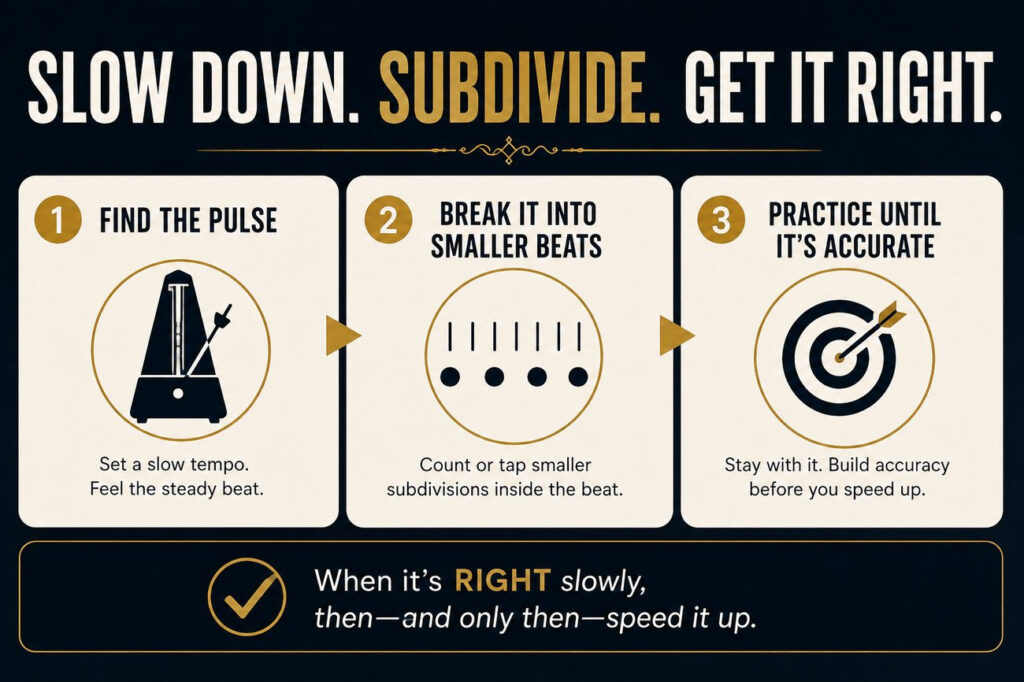
Rhythm is mathematical. If a difficult measure isn’t making sense, break it down and determine exactly where every note belongs.
Time signatures such as 6/8 can create confusion. Dotted rhythms can require you to subdivide the beat into smaller units before the larger pattern makes sense.
A metronome is useful here, but don’t use it simply to force yourself to play faster.
Use it to expose whether the rhythm is actually stable.
Take one difficult rhythmic passage from your current music and put the violin down. Clap it slowly. Count it. Subdivide it. Then play it slowly on the violin before gradually increasing the tempo. Practice doesn't automatically make perfect. Practice reinforces what you repeat. If you play the wrong rhythm 50 times, you're not practicing your way toward the correct rhythm. You're becoming extremely good at the wrong one.
8. Learn a Piece in Layers
One of the biggest mistakes advancing students make is trying to perfect everything simultaneously.
That’s not how I approached pieces with my students.

I generally thought about mastery in this order:
- Intonation
Are the notes actually in tune?
- Rhythm
Are you playing exactly what’s written?
- Articulation
Are the accents, bow strokes and articulations speaking correctly?
- Dynamics
Can you create real contrast between soft and loud?
- Vibrato & Interpretation
Are you beginning to communicate something rather than simply reproducing notes?
- Tempo
Can you bring everything together at the speed the music requires?
Notice where tempo is.
Last.
Students often want speed first because playing a piece at tempo makes it feel finished. But speed doesn’t fix the five areas before it.
It amplifies them.
How I Evaluate an Intermediate Violin Piece
This is also very close to what matters when you’re being evaluated for an orchestra.
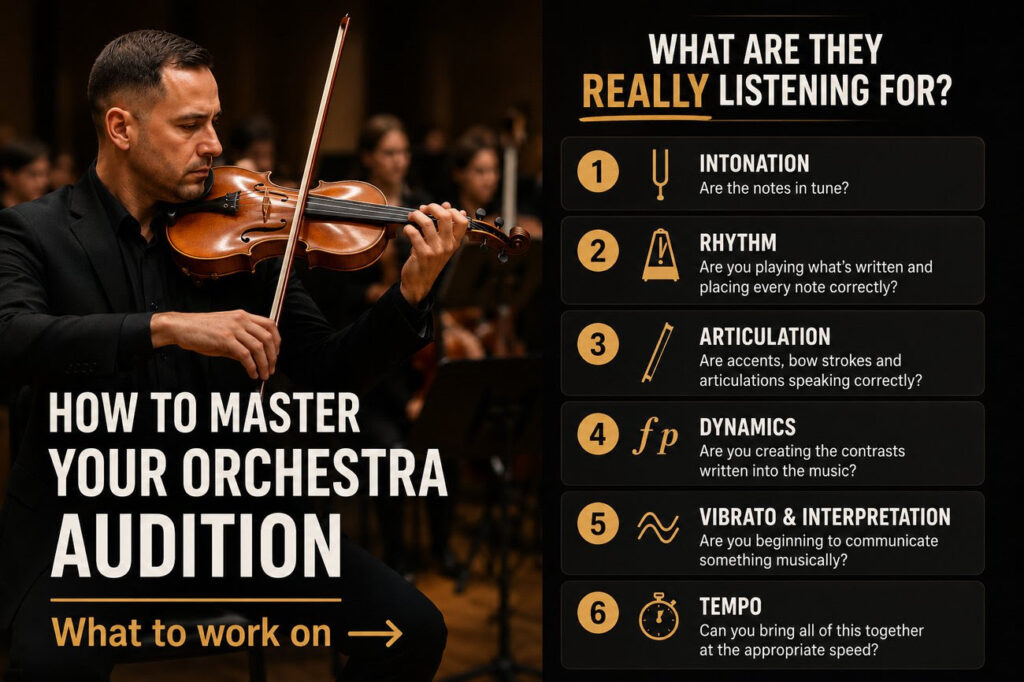
An experienced musician isn’t merely checking whether you survived every note. They’re hearing intonation, rhythm, articulation, dynamics, interpretation and your ability to bring everything together musically.
9. Don't Confuse Harder Repertoire With Better Playing
Students naturally want to progress.
New piece.
New book.
New position.
I understand the excitement, but sometimes my job as a teacher was to say:
“We’re not moving on yet.”
I remember an adult student who developed very good intonation but struggled much more with rhythm. She also needed considerable work using the index finger effectively to produce the bow pressure necessary for accents and articulation.
She wanted to progress faster than I sometimes wanted her to.
So we slowed her down.
We kept working on the areas she hadn’t mastered, and eventually she developed enough as a player to join a local adult orchestra.
That meant much more to me than simply getting her through another book.
Your Suzuki book number is not your violin ability.
Almost every student has something that comes more naturally. Maybe your ear is excellent but rhythm is difficult. Maybe rhythm is easy but your bow lacks dynamic contrast.
Don’t allow your greatest strength to hide your greatest weakness.
10. Turn Technique Into Musical Expression
There’s a wonderful point in learning a piece where the notes are right and the rhythm is right…
…but you’re still not finished.
Now the music has to speak.
This is where articulation and dynamics become increasingly important.
Your index finger has an important role in transferring weight into the bow. Developing awareness there can help you produce stronger accents, clearer articulation and greater dynamic contrast.
Then we get into vibrato and interpretation.
By the intermediate stage, I don’t want vibrato to remain simply a motion you’ve learned to produce.
I want vibrato to become part of your musical voice.

Not every note needs exactly the same vibrato. In fact, sometimes a straight tone can create more contrast and beauty than continuously vibrating everything.
The goal changes from:
“Can I vibrate?”
to:
“What do I want this note to say?”
That’s a much more interesting question
If your vibrato still feels inconsistent, you can also work through the five vibrato exercises I teach for left-hand freedom, finger pressure, movement and consistency.
How I Would Structure an Intermediate Violin Practice Session
If you take one practical idea from this entire article, I hope you’ll rethink the order of your practice.
When I taught private lessons, there was a progression I used repeatedly. I was also taught similarly throughout my own violin training.
Scales → Etude → Piece
Start with scales while your concentration is fresh.
Work on intonation, different keys, arpeggios, bowing patterns and position work.
Then move into an etude.
Use that time to isolate rhythm, shifting, articulation, dynamics or whatever technical challenge the study is designed to develop.
Then work on your repertoire.
Now you have an opportunity to apply those technical skills to actual music.
A Sample Intermediate Violin Practice Structure
| Practice Focus | Main Goal |
|---|---|
| Scales & arpeggios | Intonation, keys, shifting |
| Etude | Isolate technical weaknesses |
| Repertoire | Apply technique musically |
| Difficult passages | Slow, focused problem solving |
| Final play-through | Expression and musical continuity |
The exact amount of time you spend in each area will vary.
The order matters to me more than trying to create a universal minute-by-minute practice schedule.
Don’t treat scales and etudes as obstacles standing between you and the music. They’re part of what makes the music possible.
Why Intermediate Violinists Still Need Feedback
As you become a better violinist, your problems don’t necessarily become easier to diagnose.
Often, they become subtler.
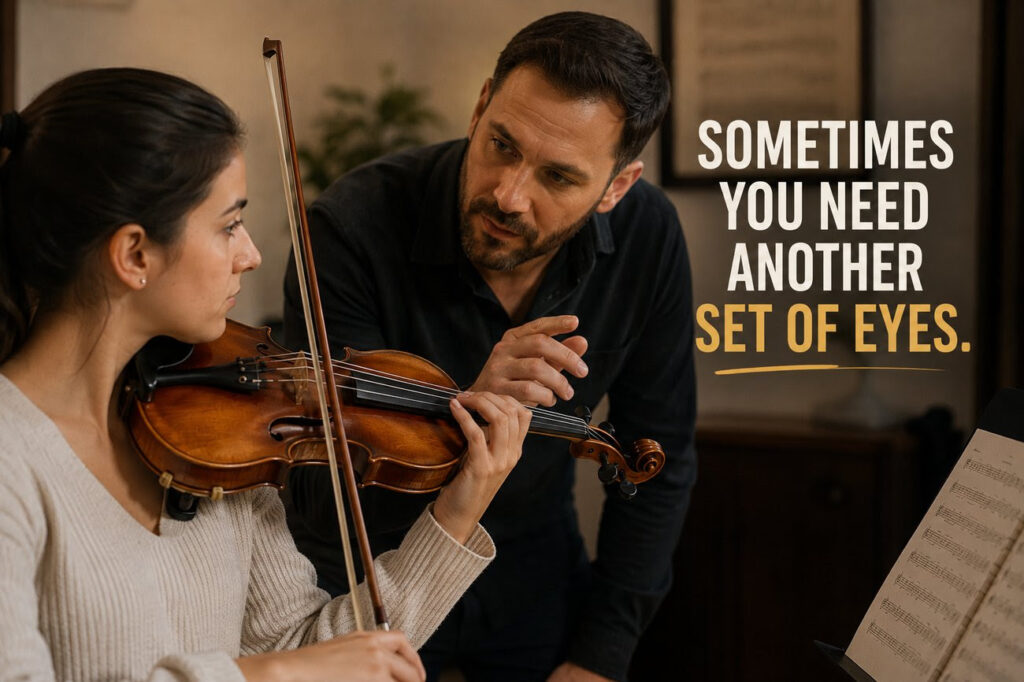
A beginner might simply need someone to show them where a finger belongs.
An intermediate student may tell me:
“My fourth finger is always flat.”
I might look at their hand and realize the bigger problem is hand height.
Someone might tell me:
“I can’t shift consistently.”
I might see that their left hand is supporting the violin or their thumb isn’t moving consistently with the hand.
Someone else may be frustrated with vibrato when the real problem is excessive finger pressure or tension.
Sometimes the hardest technical problem to identify is your own.
You’re already trying to read notes, control the bow, listen for intonation, maintain rhythm, shift, vibrate, observe dynamics and make music at the same time.
That’s a lot for one brain to evaluate objectively while you’re playing.
This is why feedback remains valuable as you advance.
Sometimes a teacher doesn’t need to give you ten new things to practice.
They need to identify the one thing that’s holding back the ten things you’re already practicing.
Not Sure What to Learn Next?
Every violinist's journey is different. Take the Find Your Violin Path Assessment for personalized guidance.
Take the Free AssessmentFinal Thoughts: Intermediate Doesn't Mean Leaving the Basics Behind
Becoming an intermediate violinist is exciting because the instrument starts opening up.
You’re shifting.
You’re exploring more keys.
Your repertoire gets harder.
Vibrato begins becoming part of your sound, and you’re developing enough control to think about articulation, dynamics and interpretation rather than simply surviving the notes.
But don’t mistake advancement for leaving the fundamentals behind.
The better you become, the more those fundamentals matter.
Practice your scales.
Work through your etudes.
Slow difficult passages down.
Pay attention to rhythm.
Keep your left hand free.
Listen carefully to your intonation.
Then add articulation, dynamics, vibrato, interpretation and eventually tempo.
The goal isn’t to get through the next Suzuki book as quickly as possible.
The goal is to become the kind of violinist who can play whatever comes next well.
Vibrato is one of the clearest examples of an intermediate technique that depends on strong fundamentals underneath it.
Continue with How to Learn Violin Vibrato: My Step-by-Step Method to see how I apply these same ideas of relaxation, finger pressure, shifting and left-hand freedom to developing vibrato.
Frequently Asked Questions About Intermediate Violin
What level is considered intermediate violin?
There isn't one universal piece, book or position that makes someone an intermediate violinist. I generally think of this stage as the transition beyond basic first-position playing into more demanding repertoire, shifting, increasingly varied key signatures and more sophisticated musical expectations. An intermediate violinist isn't just learning where the notes are anymore. You're beginning to develop the technical control needed to play those notes accurately, consistently and musically.
What should an intermediate violinist practice?
I strongly believe in building practice around scales, etudes and repertoire. Scales develop your intonation, understanding of keys and fingerboard, while etudes allow you to isolate technical challenges. Your repertoire then becomes the place where you bring those skills together and make music. Don't spend your entire practice session playing pieces from beginning to end.
Should intermediate violinists practice scales every day?
Scales should be a consistent part of intermediate violin practice. They become increasingly valuable as you work in more keys and begin shifting into third, fifth and other positions. I also recommend doing more than simply playing a scale from bottom to top. Use arpeggios, rhythmic variations, bowing variations and occasional tuner work to make scales genuine technical training.
Why is my violin playing getting harder even though I'm improving?
Because harder music exposes smaller weaknesses. A low hand position may not cause much trouble in an easy first-position melody but suddenly create fourth-finger and intonation problems during a fast passage. Excessive finger pressure might feel manageable at a slow tempo but interfere with dexterity when the music gets faster. Don't automatically interpret that struggle as a sign that you're getting worse. Sometimes you're finally playing music difficult enough to show you what needs to improve next.
When should I learn third position on violin?
Third position becomes important as your repertoire begins requiring notes and finger patterns beyond comfortable first-position playing. But I care about the fundamentals underneath the shift just as much as finding the note. Make sure the violin is supported well, the left hand is free, finger pressure isn't excessive and the thumb moves naturally with the hand. A shift shouldn't feel like you're dragging a stuck hand to another part of the violin.
Is fifth position difficult on violin?
Fifth position introduces additional demands because you're traveling farther up the fingerboard and relying increasingly on a strong physical and aural map of the instrument. This is one reason scales and shifting exercises become so valuable. Repeatedly traveling through positions helps your hand learn the distances while your ear learns where the pitch belongs. Don't approach fifth position as an isolated trick. Build the fundamentals that make all positions more reliable.
How important are etudes for intermediate violinists?
I consider them extremely valuable. I used Wohlfahrt and Mazas extensively because etudes let students focus on rhythms, shifting, articulation, dynamics and difficult technical combinations outside the pressure of simply progressing through repertoire. And don't worry if an etude takes several weeks. Finishing an etude isn't the goal. Improving because of the etude is.
How do I know whether I'm ready for harder violin music?
Don't judge readiness only by whether you can technically play all the notes. Ask whether you can play them with good intonation and rhythm. Then listen for articulation and dynamics. After those foundations are secure, think about vibrato, interpretation and ultimately tempo. If playing the harder piece requires you to abandon all the technique you've already learned, slowing down or temporarily stepping back may actually help you advance faster.
Why does my vibrato or shifting get worse in difficult pieces?
Your attention is being divided among more tasks, and difficult passages often reveal tension that isn't obvious during simpler playing. Check whether you're squeezing the neck, pressing too hard with the fingers or relying on your left hand to support the violin. Those fundamentals affect both shifting and vibrato. A free left hand has a much better chance of doing both well.
How long does it take to move from intermediate to advanced violin?
I wouldn't measure that transition primarily by time or by which Suzuki book you're playing. Students develop at different rates, and almost everyone has areas that progress faster than others. I've taught students with excellent intonation who needed much more work on rhythm, while another player may have great rhythmic instincts but need substantial technical work. Instead of asking how quickly you can reach "advanced," ask whether your intonation, rhythm, technique and musicianship are becoming consistently stronger. That's the progress that matters.
Michael Sanchez
Michael Sanchez is the founder of Lumen Corda, author of Fiddle For Dummies, and a violin educator with more than 25 years of teaching experience. He has helped hundreds of students develop stronger technique, greater confidence, and a deeper understanding of the violin. His teaching philosophy is simple: understanding creates better technique.
More About Michael