Every year, I meet students who tell me some version of the same thing:
“I don’t want to learn violin. I just want to learn fiddle.”
I understand exactly what they mean.
They aren’t dreaming about concertos or orchestra auditions. They want to play a country solo, join a jam, learn a traditional tune, or finally play a song they’ve loved for years.
They’re excited.
And I never want to take that excitement away.
But if you’re trying to figure out how to learn fiddle, there is one idea I want you to understand from the beginning:
Learning tunes and learning the instrument are not the same thing. You can memorize a surprising number of songs while still building bad habits.
Your left hand can squeeze.
Your bow can wander.
Your fingers can press too hard.
Your intonation can remain inconsistent.
Eventually, those weaknesses show up in how you sound. That’s why my approach to how to learn fiddle begins with fundamentals.
Spend your first year becoming a fundamental violinist—not because you need to become a classical performer, but because strong violin fundamentals can make you a much better fiddler.
What You'll Learn
- How to learn fiddle without building habits that limit you later
- The 7 fundamentals I would prioritize with a beginning fiddler
- Why posture, finger pressure, intonation, and bowing matter so much
- Which keys I would learn first
- Why you don't need to rush into higher positions
- How listening accelerates your understanding of fiddle
- A practical 12-month roadmap for beginning fiddle players
How to Learn Fiddle: Start With the Instrument, Not the Songs
One of the biggest mistakes I see beginning fiddlers make is focusing almost entirely on memorizing tunes.
They learn enough to get through a song…
But not enough to play it beautifully.
If your posture is poor, your left hand squeezes, your finger placement is inconsistent, or your bow never develops a reliable path, those problems eventually become speed problems, intonation problems, tone problems, and endurance problems.
Great fiddle sound isn't built by memorizing more tunes. It's built by developing solid fundamentals.
7 Powerful Steps for Learning Fiddle
1. Build a Relaxed Left-Hand Position
Good fiddle playing starts with good left-hand technique.
Your left hand should feel balanced rather than clamped around the neck. The thumb should not squeeze the neck.
Your fingers should be able to fall onto the strings without unnecessary tension.
A relaxed hand moves faster.
It changes notes more easily. And eventually, it gives you the freedom needed for more advanced fiddle tunes.
If your hand already feels exhausted after a few minutes, don’t assume you need more strength.
Very often, you need less tension.
Play a simple one-octave scale. Between each note, briefly notice your thumb. Soften it without losing control of the instrument. If the hand immediately tightens again, slow the scale down until relaxation becomes part of the movement.
2. Use Much Less Finger Pressure
This surprises almost every beginner I teach.
The violin requires far less left-hand pressure than most students think. Beginners often press the string into the fingerboard as if more force will create a cleaner note.
Almost always, that extra pressure creates tension without improving the sound. That tension eventually limits speed, flexibility, and endurance.
When faster fiddle passages arrive, the hand has to release before it can move efficiently.
Learn the minimum useful pressure early.
3. Train Accurate Finger Placement Before Chasing Speed
One of the biggest differences between an average fiddler and an exceptional one is intonation.
You can play all the correct notes…
But if those notes aren’t centered, the music loses much of its impact. That’s why I’d rather hear a beginner play a scale slowly and beautifully than rush through a fiddle tune with ten questionable notes.
Develop your ear.
Listen to ringing open strings.
Play scales carefully.
Notice patterns in where your fingers land.
Speed comes later.
Accuracy comes first.
4. Make the Bow Your Priority, Not an Afterthought
Most new players stare at the left hand because that’s where the notes are.
But the bow creates your sound.
A beginner learning how to learn fiddle should spend serious time developing a straight bow path, smooth string crossings, consistent tone, full use of the bow, and relaxed right-hand mechanics.
Those fundamentals later become the foundation for rhythmic fiddle bowing. Without them, advanced bowing patterns become much harder.
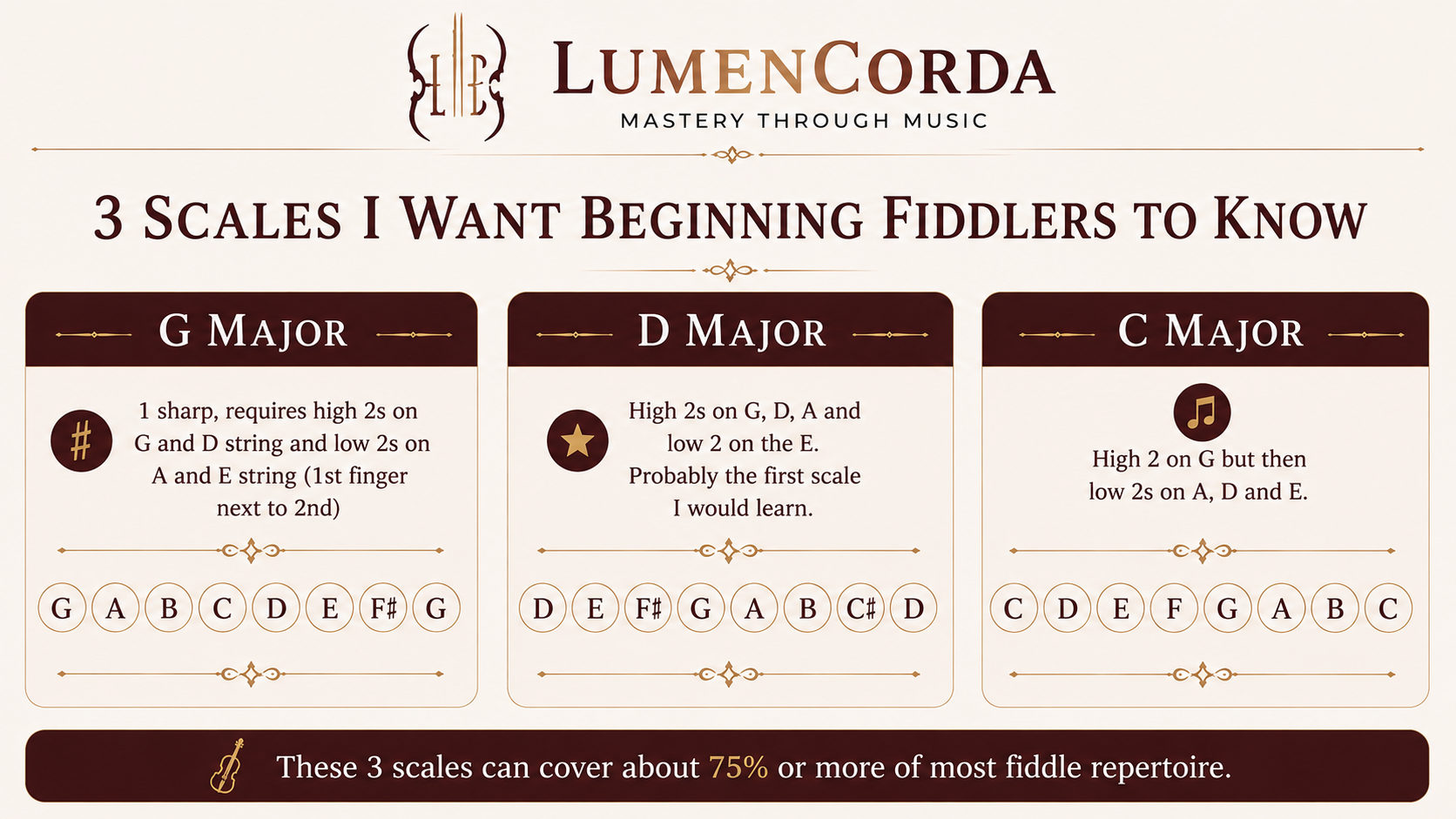
5. Master the Keys You Will Actually Use
One advantage of beginning fiddle is that you don’t need to become fluent in every key immediately.
If I were building a beginner roadmap, I would become extremely comfortable in G Major, D Major, and C Major before worrying about remote keys.
These keys give you an excellent technical foundation and appear constantly in beginner and intermediate traditional repertoire.
Scales are not separate from fiddle playing.
They teach the finger relationships, intonation, string crossings, and hand patterns that make tunes easier later.
When students ask how to learn fiddle faster, scales are rarely the answer they hope to hear.
But they’re one of the answers I trust most.
6. Don't Rush Into Higher Positions
Many classically trained violinists are surprised by how much excellent fiddle playing happens in first position.
That doesn’t mean fiddle is easy.
Far from it.
The challenge is often becoming extraordinary with the notes you already have.
Playing fast.
Playing clean.
Playing in tune.
Creating groove.
Controlling bow changes.
Adding tasteful slides.
Eventually playing expressive double stops.
You can spend years improving those skills without living high on the fingerboard.
Control is more valuable than complexity.
7. Listen as Seriously as You Practice
Practice matters.
But listening matters just as much.
When I first entered the fiddle world, I immersed myself in recordings.
The more I listened, the more I began hearing things I had completely missed before.
How the fiddle answered a singer.
How another instrument responded.
Where the player left space.
Why one tiny fill sounded so natural.
Those weren’t things I could learn from sheet music alone.
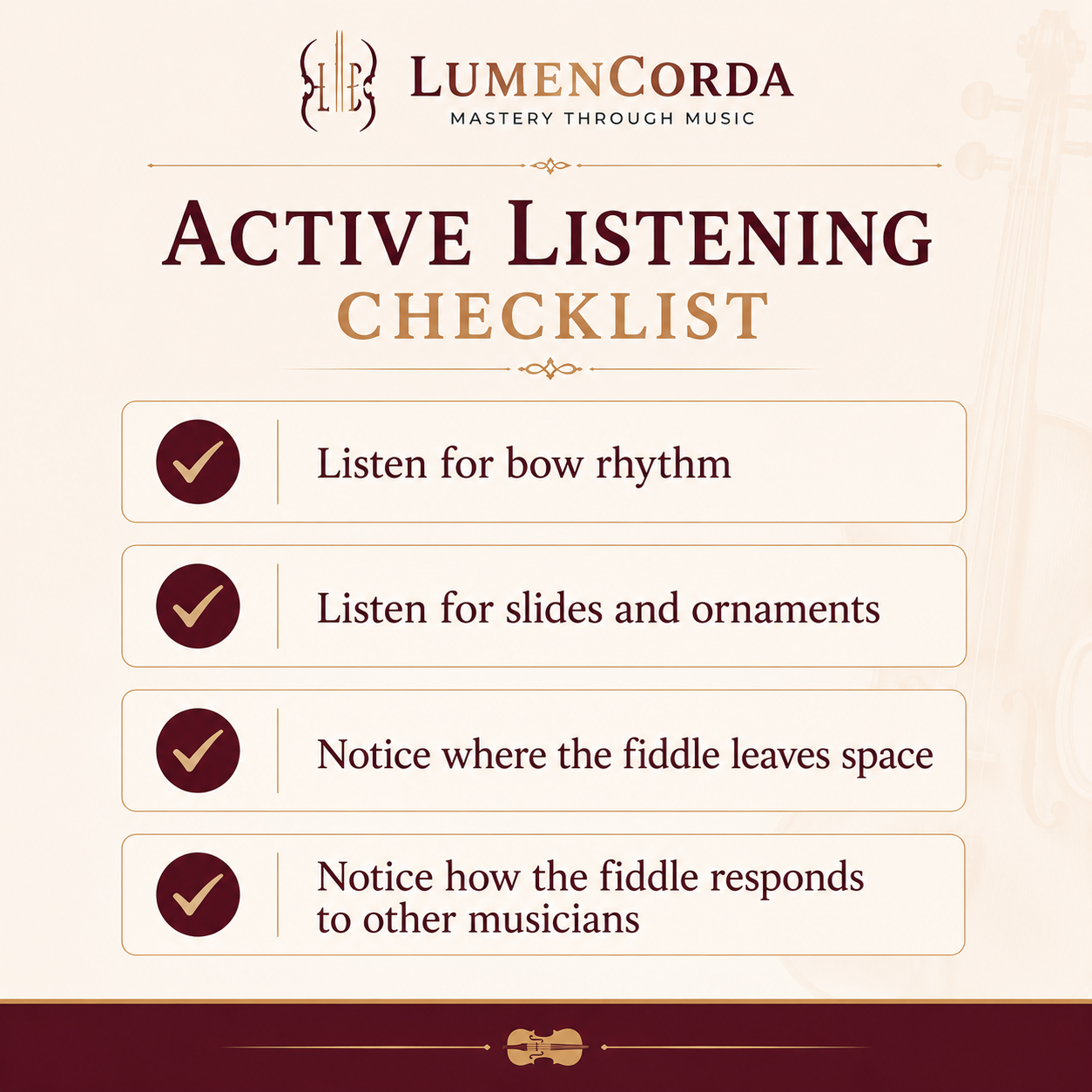
If you’re learning how to learn fiddle, listen actively.
Ask why the player chose a slide.
Notice why they didn’t play during a verse.
Listen for the bow rhythm.
Pay attention to where the phrase breathes.
Your ears often learn the style before your hands do.
You don't become a great fiddler by memorizing more songs. Surround yourself with great fiddle music until the style becomes part of how you naturally hear music.
Why Fundamentals Actually Help You Play Faster
A common beginner belief is:
“If I skip the exercises and just play tunes, I’ll improve faster.”
Unfortunately, the opposite is almost always true.
Imagine trying to drive a race car with poor steering alignment.
You might still move quickly.
But you’ll constantly fight the vehicle.
Learning how to play the fiddle works exactly the same way.
When your hand is tense, your fingers press too hard, or your bow behaves unpredictably, every passage requires more effort than it should.
I’ve watched students spend months trying to force a difficult tune to become easier.
Then we improve the posture, bow hold, or left-hand mechanics.
Suddenly, the exact same music feels dramatically more manageable.
Nothing about the tune changed.
The fiddle fundamentals changed.
A Student I'll Never Forget
One student immediately comes to mind whenever I think about how to learn fiddle with a clear goal.
He walked into my studio wanting one thing.
He wanted to play The Devil Went Down to Georgia at his wedding.
He wasn’t trying to become a classical violinist.
He wasn’t dreaming about an orchestra.
He just wanted to learn that song.
Instead of telling him to forget the dream until some distant future, we built the fundamentals around the destination.
We worked on posture.
Bow hold.
Tone.
Finger placement.
Scales.
Intonation.
Every lesson pointed toward the music he cared about.
Six months later, he performed it.
Coming from someone who couldn’t play a single note when we started, that was incredibly impressive.
The bigger lesson was that a clear musical goal made the fundamentals feel meaningful instead of tedious.
This is the song my student wanted to learn!
Me playing “The Devil Went Down to Georgia” with Stolen Horses.
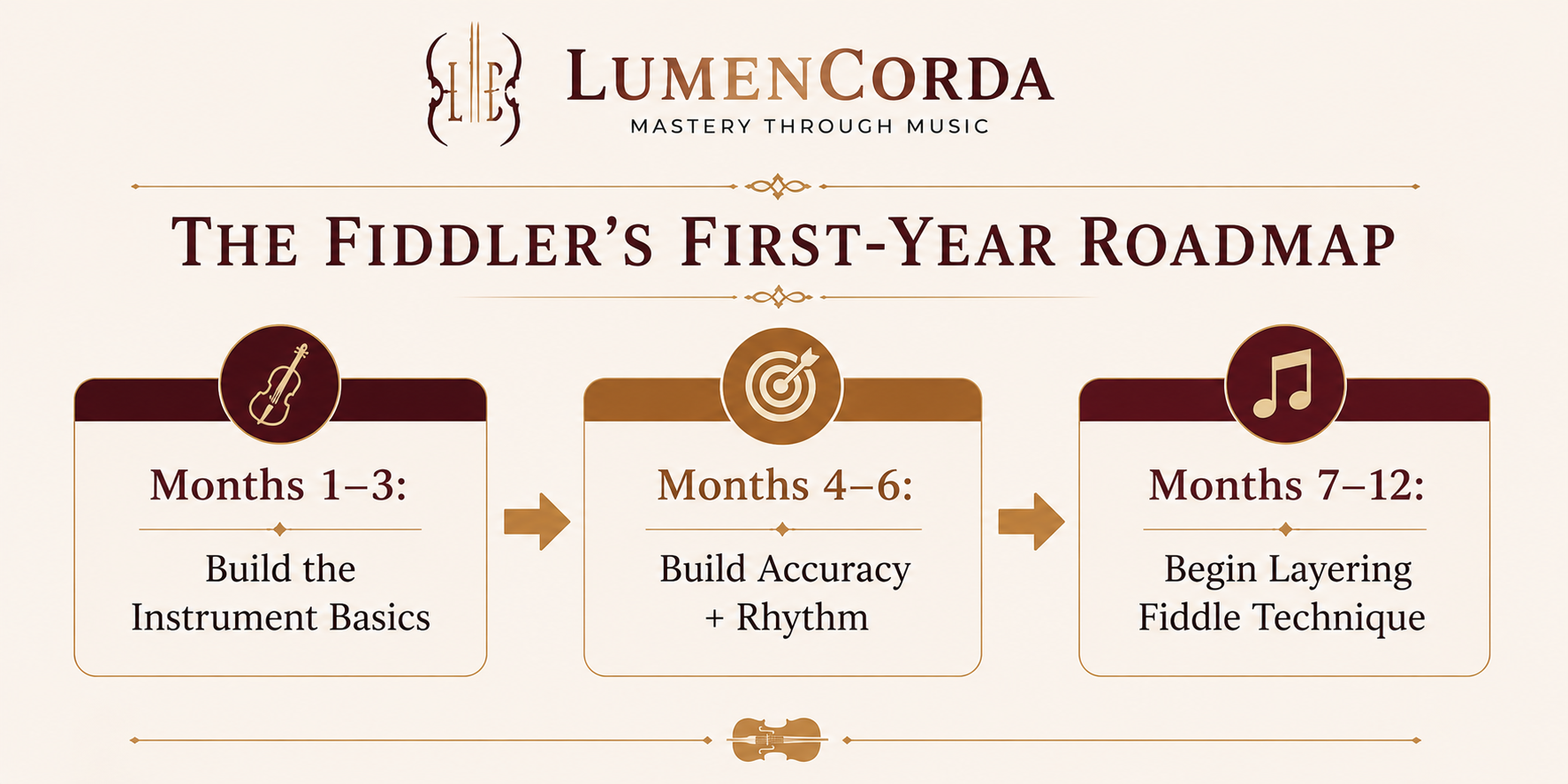
My 12-Month Beginner Fiddle Roadmap
| Time & Primary Focus | What to Introduce |
|---|---|
| Months 1–3; Posture, bow hold, straight bowing, tone, left-hand position, finger placement | Simple scales and short melodies |
| Months 4–6; G, D, and C Major; intonation; string crossings; rhythm; relaxation | Very simple fiddle tunes |
| Months 7–12; Keep strengthening fundamentals | Basic slides, easy double stops, beginning improvisation, deeper listening |
The timeline is not a race.
Some students move faster in one area and slower in another.
The important part is the order.
Build control first. Then layer fiddle technique on top of it.
When Should You Start Learning Actual Fiddle Tunes?
You do not need to wait a full year before playing anything fun.
I would introduce simple tunes once the student can hold the instrument reasonably well, create a controlled bow stroke, and place basic first-position fingers with some consistency.
The difference is that I would not let tunes replace fundamentals.
Use songs as motivation and application.
Use scales, bow work, listening, and technical exercises to keep raising your ceiling.
That balance is one of the most important parts of how to learn fiddle without getting trapped at the same technical level for years.
If you’re looking for tunes to start with, I included a large collection of fiddle tunes in my book, Fiddle For Dummies.
I wrote the book to teach the fundamentals while giving you real music to apply them to, so many of those tunes work well as you begin putting these skills into practice.
What About Vibrato?
Vibrato is not the first skill I would chase as a beginning fiddler.
But the relaxed left-hand habits you’re building now matter enormously when you eventually learn it.
If your hand squeezes the neck, vibrato becomes much harder.
If your hand is balanced and your finger pressure is light, the movement has a much better chance of developing freely.
When you’re ready for that next technique, continue with my guide to violin vibrato.
Before You Start: Understand Fiddle vs Violin
If you’re still wondering whether fiddle is actually a different instrument, start with my companion guide.
Read Fiddle vs Violin: 6 Surprising Differences You Must Know.
It explains why the instrument is the same even though the musical mindset, bowing, improvisation, and performance approach can feel very different.
Build a Fiddle Plan Around Your Current Level
You don't need every exercise on the internet. You need the right next step. Take my free assessment and I'll help you identify the skills and musical direction that make the most sense for where you are today.
Take the Free AssessmentHow do I learn fiddle as a complete beginner?
Start with basic violin fundamentals: posture, bow hold, straight bowing, relaxed left-hand position, accurate finger placement, and simple scales. Add easy fiddle tunes gradually rather than using songs as a substitute for technique. I would rather have a new player build those mechanics carefully and learn a few simple tunes well than rush through a large song list with tension and inconsistent intonation.
Do I need to learn violin before I learn fiddle?
You do not need years of classical repertoire first, but I strongly recommend learning solid violin fundamentals. The same mechanics that create good violin technique also make speed, intonation, bowing, double stops, and fiddle ornamentation easier. My philosophy is not that you need to become a classical performer first; it is that you should learn to handle the violin well enough that your technique does not become the thing limiting your fiddle playing.
How long does it take to learn fiddle?
You can begin playing simple tunes within months, but becoming a strong fiddler is a long-term process. Your pace depends on practice consistency, prior musical experience, instruction, and how carefully you build technique. I had one beginning student work toward The Devil Went Down to Georgia for his wedding and perform it after about six months, but that was a specific goal supported by focused work on fundamentals. Becoming a polished, versatile fiddler is a much longer journey.
Can adults learn fiddle?
Absolutely. Adults can learn fiddle at any age. A patient approach to posture, relaxation, intonation, bowing, and listening is much more important than starting young. Adults often bring patience, strong musical goals, and the ability to practice deliberately, all of which can help enormously.
What scales should a beginner fiddler learn first?
I would prioritize G Major, D Major, and C Major. These keys build useful first-position patterns and prepare you for a large amount of beginner and intermediate repertoire. I like these because they build useful patterns without sending a beginner into every possible key before the basics are stable.
Should I learn fiddle by ear or from sheet music?
Both can be useful. Reading gives you a clear way to learn notes and rhythms, while listening and learning by ear help you absorb phrasing, bowing, groove, ornamentation, and improvisational language. In my experience, the ear becomes especially important because so much of fiddle style lives in details that notation does not fully communicate—groove, slides, fills, space, and the way musicians respond to one another.
How often should a beginner practice fiddle?
Consistency matters more than marathon sessions. A focused daily routine that includes technique, scales, bow work, listening, and a small amount of repertoire will usually beat occasional long sessions. Even a shorter session can be productive when it has a purpose: a little bow work, a scale, one technical focus, and then music you actually enjoy playing.
Is fiddle hard to learn?
The basics are approachable, but excellent fiddle playing is difficult. Speed, rhythm, intonation, bow control, double stops, listening, improvisation, and stylistic phrasing can take years to develop. You may be able to play recognizable tunes fairly early, but there is a huge difference between getting through the notes and making a fiddle tune really sound convincing.
Can I teach myself fiddle?
You can make progress with high-quality instruction and careful self-observation, but feedback is extremely valuable because tension, bow-path problems, and left-hand habits can be difficult to notice on your own. A mirror, recordings of your own playing, and careful listening can help, but an experienced teacher can often spot a squeezing thumb, crooked bow path, or posture issue before it becomes deeply ingrained.
Want a Step-by-Step Fiddle Method?
If you’re ready to start learning actual fiddle tunes while continuing to build strong fundamentals, I wrote Fiddle For Dummies specifically around that approach. The book walks you through the fundamentals of playing the fiddle—from proper technique and bowing to scales, rhythm, and essential skills—and includes dozens of fiddle tunes and musical examples so you can put those skills into practice. It’s a great next step if you want a structured path that combines learning how to play the fiddle with actually playing fiddle music.
→ Learn About My BookMichael Sanchez
Michael Sanchez is the founder of Lumen Corda, author of Fiddle For Dummies, and a violin educator with more than 25 years of teaching experience. He has helped hundreds of students develop stronger technique, greater confidence, and a deeper understanding of the violin. His teaching philosophy is simple: understanding creates better technique.
More About Michael