Violin lessons for kids can be incredibly rewarding, but the lesson itself is only part of what determines how much a child progresses.
After more than 25 years of teaching, I’ve seen a tremendous difference between students whose parents are actively involved in the learning process and those whose parents simply drop them off for lessons and hope for the best.
I can also look at this from the other side.
I started violin when I was four years old. My earliest clear memories of playing are probably from around age six or seven, and before I turned 18, I studied with seven different private violin teachers.
My mom wasn’t a musician. She worked incredibly hard, paid for years of lessons, and gave me opportunities that ultimately changed my life.
I’m incredibly grateful for that.
But becoming a violin teacher myself gave me a new perspective on my childhood. There were things my mom simply didn’t know to ask, and there were times I probably could have progressed much faster if someone at home had understood exactly what my teacher wanted me to work on.
That’s why I believe parents have a much bigger role in successful violin lessons for kids than they may realize.
And no—you don’t need to know how to play the violin yourself.
💡 What You'll Learn
- Why parent involvement can make violin lessons for kids more productive
- How to tell whether your child's violin practice is actually accomplishing something
- Why the most advanced or expensive violin teacher isn't always the best teacher for a child
- How to balance discipline with making violin enjoyable
- Why orchestra, auditions and stronger musicians can accelerate a child's development
- How to recognize normal plateaus without assuming your child lacks talent
- How to help your child think of themselves as a violinist—not simply a kid who takes lessons
Parents Matter More Than They May Realize
One of the clearest patterns I’ve seen while teaching children is the difference between parents who understand what’s happening in lessons and parents who don’t.
Some parents sat in the room during lessons.
They listened.
They knew which scales we were working on, which etudes had been assigned, which passages were causing trouble and which technical habits I was trying to correct.
Those parents could become almost like an extension of my teaching at home.
They weren’t teaching the violin themselves.
They simply knew what we were trying to accomplish.
Then there were parents who dropped their child off and returned when the lesson was finished.
Those children might still go home and practice, but there was a problem.
Practice could easily become playing whatever songs they felt like playing that day.
The child might barely touch the scale I assigned.
They might avoid the difficult passage we spent 15 minutes fixing.
They might repeatedly make the same technical mistake I wanted corrected.
And the parent wouldn’t necessarily know.
Over the years, some of the students I saw develop the most persistent bad habits were the ones without much parental involvement outside the lesson.
A parent doesn't need to become the violin teacher. The parent needs to understand what the violin teacher is trying to accomplish.
Sit in on lessons when possible.
Listen to what the teacher is correcting.
Know what’s supposed to happen before the next lesson.
Ask questions when something isn’t clear.
This is one of the simplest ways parents can get more value from violin lessons for kids.

Violin Practice Time Is Not the Same as Violin Progress
One of the biggest misconceptions I see is the idea that practice time by itself determines improvement.
Time certainly matters.
But how your child practices matters tremendously.
Imagine two students.
One practices for 60 minutes. They play their favorite pieces from beginning to end, skip their scales, barely touch the etude their teacher assigned and repeatedly play through mistakes without stopping.
Another practices for 30 minutes.
That student works on the assigned scale, spends several minutes on an etude, isolates the four measures their teacher identified as a problem and repeats them carefully. Then they finish by playing something they enjoy.
Which student had the better practice session?
I’d choose the second one.
An hour with a violin in your hands isn’t automatically an hour of productive violin practice.
This is where involved parents have an enormous advantage.
When you understand what happened during the lesson, you can help your child remember what they’re actually supposed to accomplish during the week.
Violin Practice Tips Parents Should Know
You don’t have to understand advanced violin technique to improve the structure of practice at home.
Start with purpose.
Before practice begins, your child should have some idea of what they’re trying to accomplish.
That might mean:
- working on an assigned scale;
- practicing an etude;
- isolating a difficult section of repertoire;
- correcting a specific habit the teacher identified;
- preparing for an audition or chair test;
- and spending some time playing music they genuinely enjoy.
The exact assignment should come from the teacher.
Your job is to help prevent “practice” from becoming 30 or 60 minutes of playing whatever feels easiest.
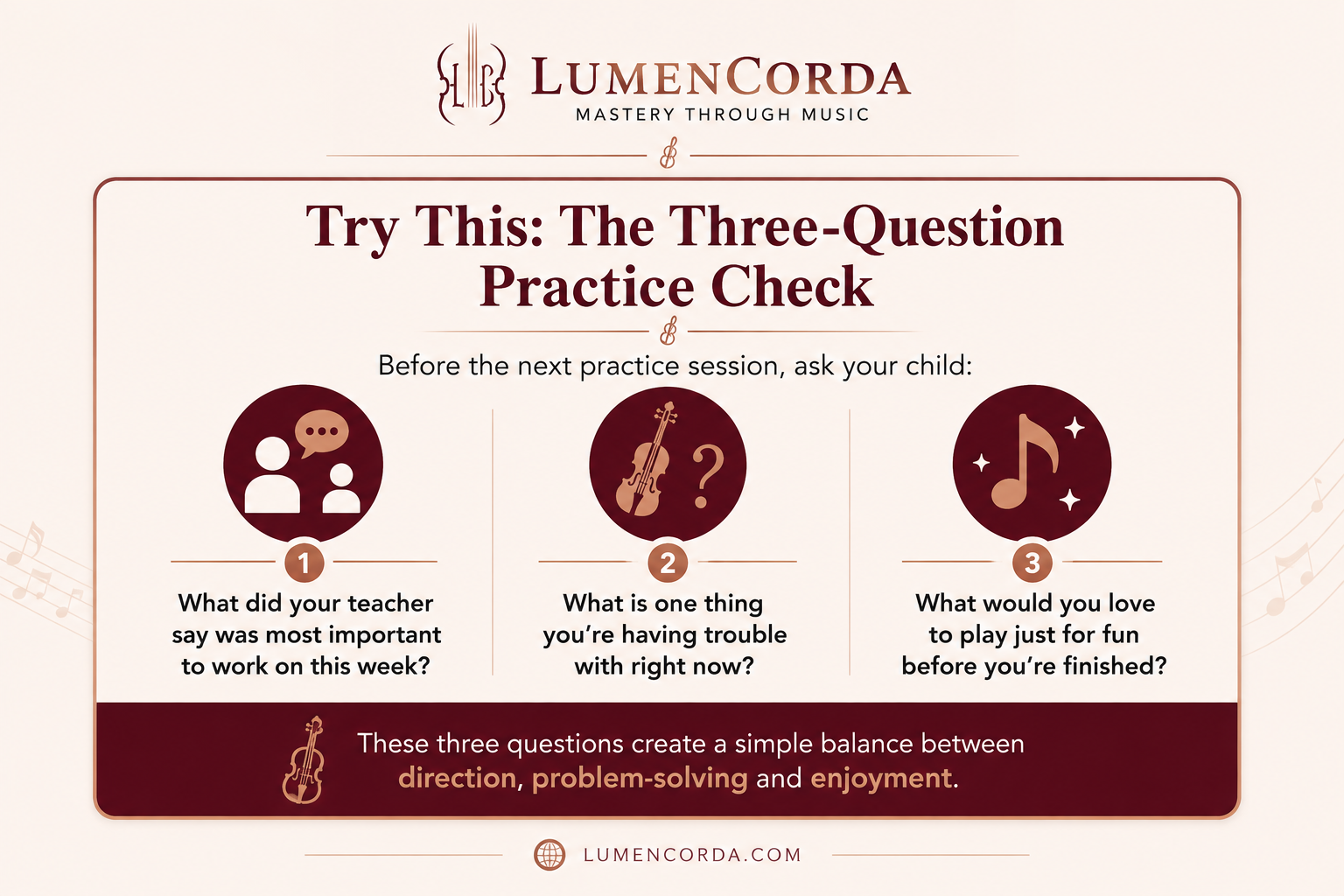
How Much Should Kids Practice Violin?
Parents researching violin for kids understandably want to know how much practice is enough.
I don’t think there’s one number that applies to every child.
Age, maturity, goals, ability and motivation all matter.
But these are reasonable general starting expectations from my teaching perspective:
| Age / Stage | General Practice Expectation |
|---|---|
| Under age 7: Build the habit | Around 60 total minutes per week |
| Ages 7–9: Increase consistency | Around 120 total minutes per week |
| Ages 10–12: Develop discipline | Around 240 total minutes per week |
| Teen years: Practice toward goals | Time can increase substantially with commitment and motivation |
I don’t view these numbers as rigid rules.
A teenager hoping to win a youth symphony audition has very different needs from a six-year-old who is just beginning violin.
The bigger principle is:
Combine enough practice time with the right kind of practice.
That’s where I see kids really excel.
What If Your Child Doesn't Want to Practice Violin?
Discipline is one of the biggest challenges with students under 18.
That’s normal.
But when a child constantly resists practice, I don’t think the answer should automatically be, “My child is lazy.”
Look deeper.
Is the teacher engaging?
Does the child enjoy any of the repertoire?
Are the expectations clear?
Does your child understand what they’re working toward?
Is there anything about violin that feels fun?
I’ve had some wonderful teachers in my own life.
I’ve also had teachers whose lessons I dreaded.
And looking back at those seven teachers taught me something important about violin lessons for kids:
The teacher can dramatically affect the child’s relationship with the instrument.

I Had Seven Violin Teachers Before I Turned 18
My first teacher taught using the Suzuki Method.
There was a system. I have great memories of those early years, and I believe that foundation set me up well.
Another teacher wasn’t particularly outside-the-box. We went through pieces and practiced, but there wasn’t much vision or encouragement.
To me as a child, the experience felt boring.
Another teacher was fun, smiled a lot and had big goals for me. She was competent, although those goals weren’t always connected to what motivated me personally.
Then I had a teacher who found a balance I really liked.
We worked on the things I needed to work on, but she also considered pieces that were fun for me.
I wanted to do my best for her.
Later, I studied with one of the most advanced teachers in town.
If I had been completely committed to becoming a conservatory-level classical violinist, she may have been an excellent fit.
But that wasn’t necessarily what I needed emotionally at that stage.
I needed more motivation.
I needed more fun.
I often didn’t connect with the books and methods being presented to me.
I eventually had another teacher whom I remember as one of the best teachers I ever had, although I studied with that teacher for only a short period.
And toward the end, I took several lessons with one of the most expensive teachers in town. Again, the teacher’s credentials weren’t the problem.
The fit wasn’t really taking me somewhere new.
Looking back at all seven experiences has shaped the way I think about teaching children.
Frequently Asked Questions About Violin Lessons for Kids
What age should kids start violin lessons?
There isn't one perfect age for every child. I personally started violin at four, although my earliest clear memories of playing are from around six or seven. For very young children, I care less about long practice sessions and more about creating positive experiences, establishing basic habits and finding a teacher who knows how to work well with young students. The child's maturity and the teacher's approach can matter as much as the number on the birthday cake.
Should parents sit in on violin lessons for kids?
Especially with younger students, I see a major advantage when parents understand what's happening during the lesson. You don't need to understand violin technique yourself. Listen to what the teacher is correcting, know what's assigned and ask what should receive the most attention before the next lesson. Some of the most successful students I've taught had parents who became almost like my teaching hand at home—not because they taught violin, but because they understood what I was trying to accomplish.
How much should kids practice violin?
My general starting expectations are around 60 total minutes per week for children under seven, around 120 minutes under 10 and around 240 minutes under 13. Teenagers can practice substantially more depending on their goals and commitment. But I don't want parents to focus so heavily on minutes that they miss the bigger issue. Intentional practice matters just as much as practice time.
How can I make my child practice violin?
Start with structure and accountability, but don't ignore enjoyment. Make sure your child knows exactly what the teacher assigned. Then work with the teacher to find music the child enjoys in addition to scales, etudes and serious repertoire. If practice is a constant battle, I would also examine the teacher-student relationship. Sometimes the problem isn't simply that a child "doesn't like violin." The teaching approach may not be bringing the best out of that particular student.
How do I choose the best violin teacher for my child?
Look beyond price and credentials. I want a teacher to have strong technical knowledge, but for an under-18 student I also care enormously about connection and motivation. I had seven teachers before I turned 18. Some were extremely accomplished, but the teachers who made me want to do my best had something beyond technical expertise—they connected with me. The best teacher is the one who can teach your child correctly while also helping them want to continue growing.
Is school orchestra enough for a child learning violin?
It depends on the child and the orchestra. My school orchestra gave me ensemble experience, but I was already far ahead of most of the program and remained first chair. My biggest growth came when I entered more challenging extracurricular programs with difficult repertoire, stronger musicians, auditions and chair placements. If your child is significantly ahead of their school program, I would look for additional opportunities rather than assuming being first chair means they're receiving all the challenge they need.
Is it normal for a child to stop improving at violin?
Yes. Progress can come in waves. I describe learning violin as two steps forward and one step back. A student can improve rapidly and then encounter a technique or piece that temporarily makes everything harder. Don't immediately interpret a plateau as a lack of talent. Talk to the teacher, look at the child's practice habits and determine whether the student is actually struggling because the material has become more demanding.
What if my child wants to quit violin?
I wouldn't automatically treat a temporary lack of motivation as a final decision. Look at the entire environment first. Is the teacher a good fit? Is the repertoire engaging? Does your child have meaningful goals? Are there performances, orchestras or musical friends making violin feel like something beyond practice at home? At the same time, I don't believe constant misery should simply be ignored. Sometimes a different teacher, new repertoire or a new musical environment can reveal whether the child dislikes violin itself or simply dislikes their current experience of learning it.
Does my child need to be talented to succeed at violin?
From a parent's perspective, I would focus less on trying to determine whether a young child has some fixed amount of "talent" and more on the environment you're creating around them. A strong teacher, productive practice, parent involvement, appropriate challenges and consistent opportunities to perform can all influence development. Children also progress at different speeds. A difficult month doesn't tell you what your child may be capable of several years from now.
🎻 What’s the Right Next Step for Your Child?
Every young violinist’s journey is different. Take the Free Violin Path Assessment to get personalized guidance based on your child’s experience, level, and goals.
Take the Free AssessmentFinal Takeaway
After experiencing violin lessons for kids from both sides—first as a child who started at four and later as a teacher—I keep coming back to the same conclusion:
Don’t outsource your child’s entire violin journey.
Find a great teacher, but stay involved.
Encourage practice, but understand what productive practice actually means.
Let your child have fun, but don’t remove every challenge.
Join an orchestra, but make sure the environment actually creates growth.
Expect progress, but understand that it won’t happen in a perfectly straight line.
And give your child opportunities to perform, audition, play with other musicians and experience violin outside the practice room.
Your job isn’t to become their violin teacher.
Your job is to help create the environment where their teacher can bring the best out of them—and where your child has the opportunity to become a lifelong violinist.
Michael Sanchez
Michael Sanchez is the founder of Lumen Corda, author of Fiddle For Dummies, and a violin educator with more than 25 years of teaching experience. He has helped hundreds of students develop stronger technique, greater confidence, and a deeper understanding of the violin. His teaching philosophy is simple: understanding creates better technique.
More About Michael